


R E I N C A R N A T I O N
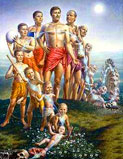 Reincarnation vs. Christian Faith
Many people of our time, who in their religious disorientation take refuge in deviant Far Eastern concepts, also believe in rebirth in the sense of the transmigration of souls. The doctrine of reincarnation describes notions that the human soul is reborn in a new body after death. Closely linked to this is the assumption that every human action inevitably has a consequence - the so-called karma, which usually only takes effect in the next life.
According to the Buddhist view, the cause of rebirth lies in the roots of karma, namely in greed, hatred, lack of insight, and delusion. The latter consists in the human being seeking fulfillment in the earthly realm, which inevitably leads to painful experiences. To escape this suffering, the Buddhist strives for enlightenment, through which he overcomes delusion and subsequently also greed and hatred, thereby attaining the state of Nirvana. This also ends the cycle of rebirths. In Nirvana, the soul is liberated from all thoughts and feelings; there is no suffering, but also no happiness and no love.
The Christian Perspective
The Holy Apostle Paul gives such ideas a clear rejection by writing: "And just as it is appointed for mortals to die once, and after that the judgment" (Heb 9:27).
"Christian revelation excludes reincarnation and speaks of a fulfillment that man is called to realize in the course of a single earthly existence."
- John Paul II
If man could redeem himself by passing through many lives, the death of Jesus Christ on the cross would have been in vain. Redemption is a gift of grace. Man cannot save himself. Anyone who believes in reincarnation contradicts the necessity of redemption through Christ.
Reincarnation and Cultural Christianity
Why, then, do some "cultural Christians" still believe in it? Often, attempts are made to reinterpreting passages in the Bible (such as the return of Elijah in John the Baptist) as reincarnation. However, the Church officially condemned this as heresy as early as 553 at the Second Council of Constantinople.
The belief in reincarnation stands in stark contrast to the Christian view of the human person. The body-soul unity of man undergoes a dissolution in this doctrine, and the body is devalued because it no longer essentially belongs to the human being, as it is repeatedly replaced in the cycle of rebirths. Furthermore, if everyone who has not fulfilled their quota in one life is given more and more lives, the process will naturally lead everyone to achieve the goal in the end, and Jesus' urgent warnings about eternal damnation would not have to be taken seriously. Holy Scripture encourages us to make good use of this one life on earth. In this life, God grants every human being all the graces necessary for salvation.